What is diversification and why does it matter?
A practical guide to spreading risk without turning your portfolio into a random collection of holdings.
Introduction
Diversification is one of the most repeated words in investing, but many beginners hear it so often that it becomes vague. At its simplest, diversification means not depending too heavily on one outcome.
That can apply to one company, one sector, one country, one currency, or one economic theme. The practical question is how much of your result depends on one thing going right.
Why this matters
Markets are unpredictable. Even good research can be wrong. Diversification helps reduce the damage from a single mistake or shock. It does not remove risk, but it can make the overall experience more survivable.
For beginners, that matters because staying invested is often harder than choosing an idea in the first place.
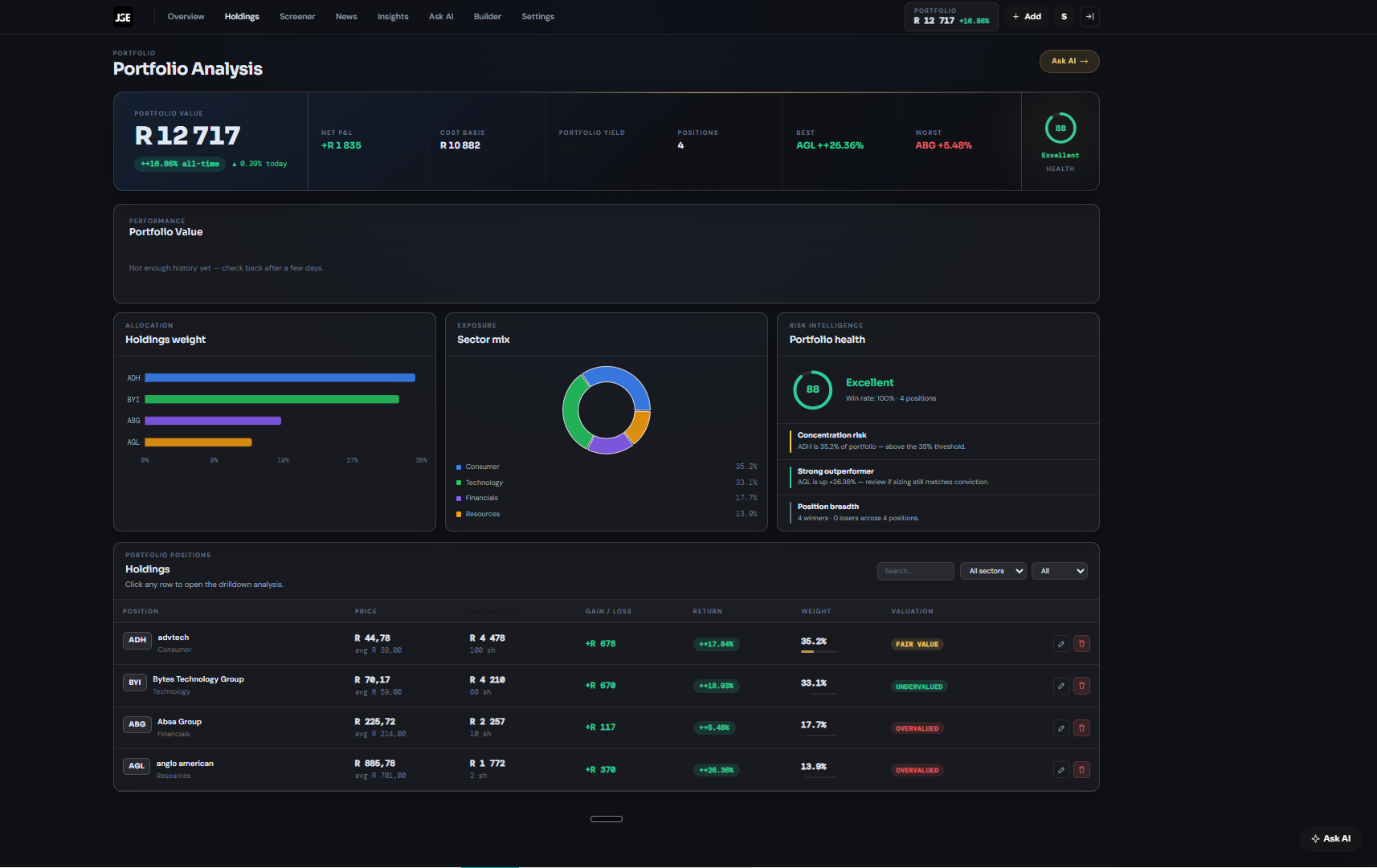
Use the holdings tools to see where your portfolio may already be concentrated.
Get early accessA simple explanation
If all your money is in one company, one bad update can change everything. If your money is spread across different holdings that do not all behave the same way, one bad outcome has less power over the whole portfolio.
Diversification is not only about the number of holdings. Five companies in the same sector can still leave you concentrated in one theme.
South African context
Diversification matters a lot on the South African market because the local market has strong sector weights and specific macro drivers. Banks, miners, retailers, telecoms, and offshore-exposed groups react differently to rates, commodity prices, and the rand.
A South African investor may also need to think about whether their job, property, and spending are already tied to the local economy. That makes portfolio balance more than a theory exercise.
A practical beginner example
A beginner who owns only financial shares may think they are diversified because there are several company names. But if all those businesses respond similarly to rates and local credit conditions, the portfolio may still be heavily concentrated.
By contrast, a mix of broad exposure, a few sectors, and clear position limits may behave more steadily even if it contains fewer total holdings.
Common mistakes
A common mistake is diversifying by count instead of by actual risk. Another is owning many things without understanding them, which can create the appearance of safety without real control.
Beginners also sometimes over-diversify out of fear, which makes the portfolio difficult to follow. There is a difference between spreading risk and dissolving conviction completely.
How Rand Pulse helps
Rand Pulse is useful because it makes concentration visible. Instead of guessing, you can look at weights, sectors, and tracked names in one place. That makes diversification a reviewable portfolio habit rather than a vague aspiration.
The free plan lets you track up to 3 stocks while you learn what concentration feels like. Premium gives you unlimited tracking, advanced AI analysis, and a fuller portfolio workflow for ongoing review.
Key takeaways
Diversification means reducing dependence on one outcome, not simply owning more tickers. Real diversification looks at sectors, themes, currencies, and position sizes together.
This content is educational and not financial advice. A useful beginner question is always: what am I still concentrated in, even if I own several holdings?
Next step
See your portfolio more clearly
Track 3 stocks for free, then unlock unlimited tracking and advanced portfolio tools when you need more depth.
Get started free
Start investing with clarity
Create a free account to access beginner-friendly South African share research, portfolio tools, and Shariah-aware screening. The free plan includes up to 3 tracked stocks — premium unlocks unlimited tracking, advanced AI analysis, and full portfolio tools.