What are South African shares and how do they work?
A clear explanation of what it means to own shares in a South African listed company.
Introduction
When people say they own shares, they mean they own a small piece of a company. In South Africa, that could be a bank, a miner, a retailer, a telecoms company, or another listed business. It sounds simple, but the meaning gets lost once prices and market noise take over.
For beginners, it helps to separate the business from the ticker. A share is not just a line moving up and down. It is a claim on part of a real company with profits, debt, risks, customers, and management decisions behind it.
Why this matters
If you do not know what a share actually represents, it becomes easy to buy for the wrong reasons. You may react to momentum, social chatter, or a cheap-looking price without understanding what the company does.
Understanding the mechanics helps you research more calmly. Instead of asking only whether the price will rise, you start asking whether the business deserves the current valuation and what could change that view.
Use the Screener to compare South African stocks by sector, risk, and valuation instead of guessing from headlines.
Preview the ScreenerSouth African market context
South African shares are shaped by local realities. Interest rates matter for banks and consumers. Commodity prices matter for miners. The rand matters for companies with offshore earnings or imported inputs. Local politics, regulation, power supply, and consumer health can all affect company performance.
That is why a local bank should not be analysed the same way as a mining company or global-feeder ETF. Sector context is not a small extra. It is part of the basic picture.
A practical beginner example
Say two companies both trade at similar share prices. One may be a stable mature business paying dividends, while the other may be a more volatile growth business reinvesting cash. The price alone tells you almost nothing about which one is safer or more suitable for your goal.
A better beginner question is: what business am I owning, what makes it money, what could hurt it, and what role would it play in my portfolio?
Common mistakes
One common mistake is thinking a lower price per share means a company is cheaper. It does not. Another is assuming a familiar brand automatically means a good investment. A great company can still be a poor buy if the price already assumes too much.
Beginners also often compare companies across completely different sectors without adjusting for how those sectors work. That leads to weak conclusions and false confidence.
How Rand Pulse helps
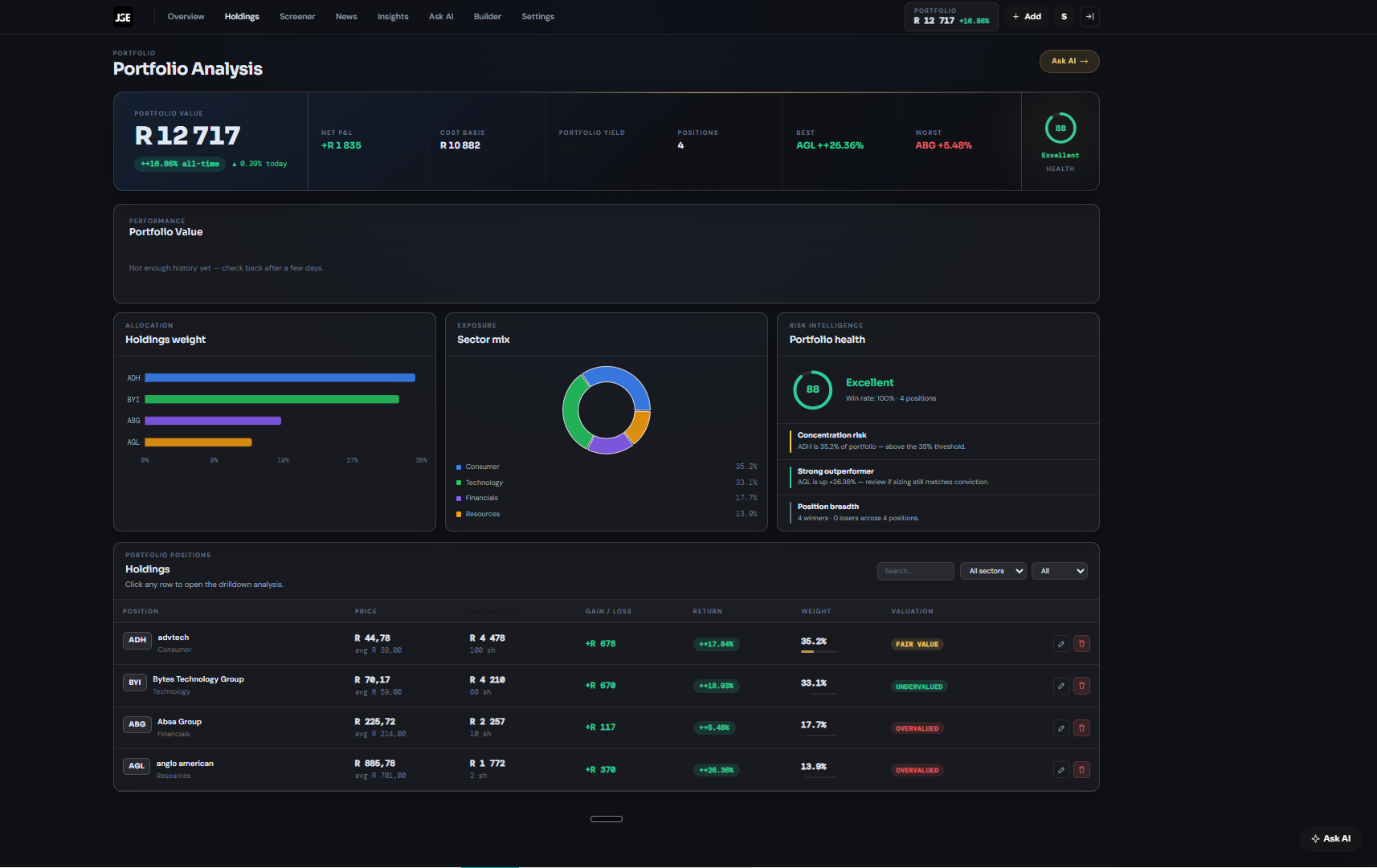
Rand Pulse is useful here because it turns separate pieces of research into one workflow. You can compare companies in the Screener, open a stock page for fundamentals and risk signals, and keep up to 3 stocks on the free plan while you learn how the market behaves.
If you want more depth, premium unlocks unlimited tracking, advanced AI analysis, and fuller portfolio tools so your stock research can feed into an actual monitoring process.
Key takeaways
A share is part ownership in a business, not just a price line. The business, the sector, the local economy, and the valuation all matter when you decide whether the share belongs on your watchlist.
This content is educational and not financial advice. A strong beginner habit is learning to describe the business before forming a view on the ticker.
Next step
See how South African shares compare side by side
Track up to 3 stocks on the free plan, or unlock unlimited tracking and advanced research with premium access.
Get started free
Start investing with clarity
Create a free account to access beginner-friendly South African share research, portfolio tools, and Shariah-aware screening. The free plan includes up to 3 tracked stocks — premium unlocks unlimited tracking, advanced AI analysis, and full portfolio tools.