Best South African stocks for beginners: how to think about them
A framework for evaluating beginner-friendly South African shares without turning the article into a list of tips.
Introduction
Beginner investors often search for the best South African stocks because they want a shortcut. That is understandable. The problem is that a shortcut can turn into a blind spot very quickly. The better question is not which stock is best in general, but what makes a stock easier or harder for a beginner to understand.
A helpful beginner framework focuses on business simplicity, sector risk, valuation discipline, and portfolio fit. That is more useful than a list of names with no context.
Why this matters
New investors can get pulled into names that are exciting but poorly understood. That often leads to decisions based on popularity, social proof, or fear of missing out. The result is not just financial risk. It is confusion when the share price moves against you and you do not know why.
Learning how to think about candidate shares helps you stay calmer and make decisions you can later review.
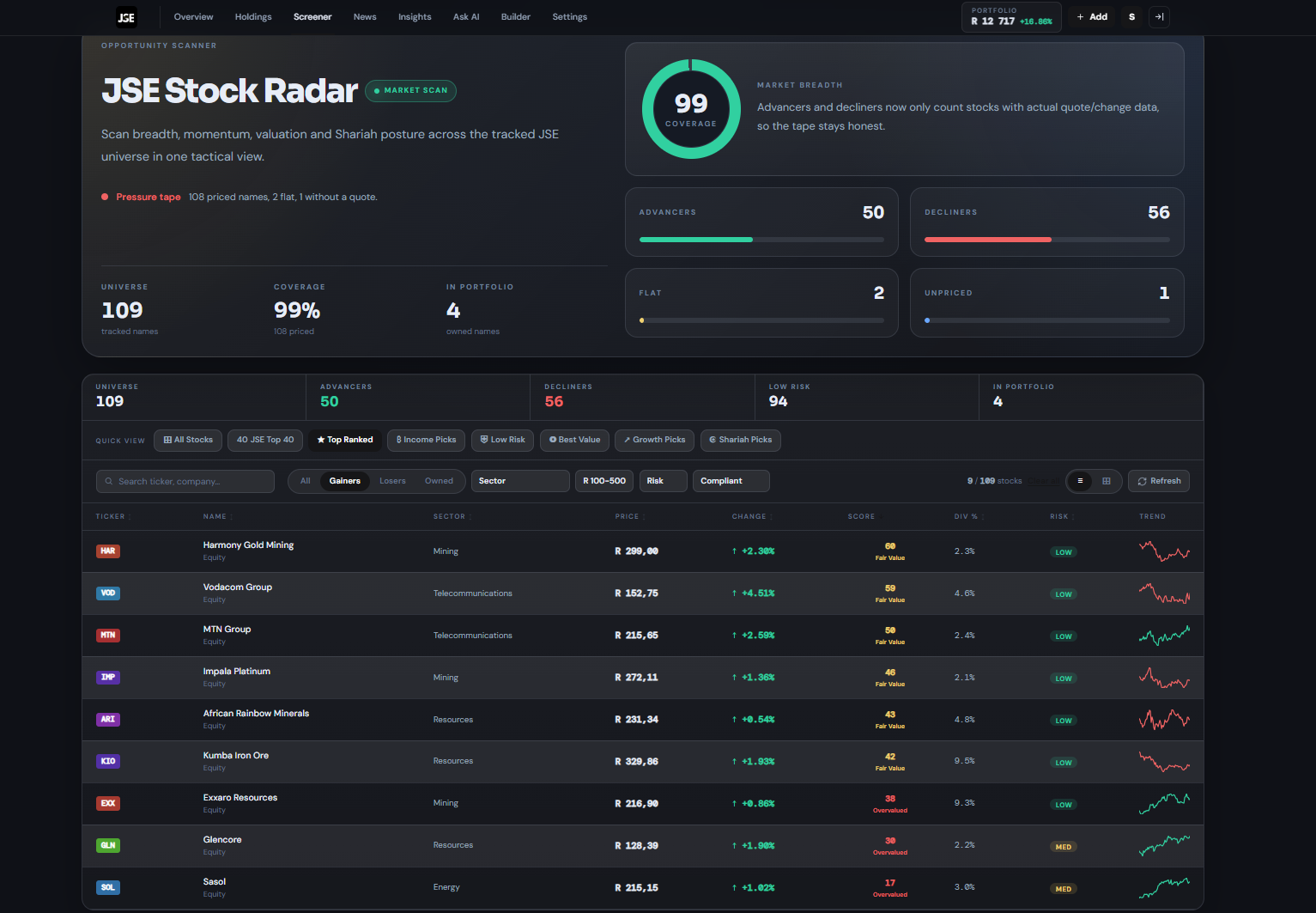
Use the Screener to compare South African stocks by sector, valuation, risk, and dividend profile in one place.
Open the ScreenerA useful way to define beginner-friendly
A beginner-friendly stock is usually one whose business model you can explain in plain language. You should be able to describe what it sells, what makes it money, which risks matter most, and what would make the investment case weaker.
That does not mean the company is safe or automatically suitable. It means you can actually follow it, which is a good starting point if you are still building your investing vocabulary.
South African market context
On the South African market, some sectors are easier to follow than others for beginners. Retailers, telecoms companies, diversified ETFs, or familiar large-cap shares may feel more intuitive than highly cyclical or heavily leveraged businesses. But sector familiarity should not replace research.
South African context still matters. Consumer weakness, rates, the rand, commodities, regulation, and electricity supply can shape results in ways beginners should not ignore.
A practical beginner example
Suppose you are comparing two ideas. One is a broad ETF. The other is an individual company in a sector you do not understand well. Even if the second looks more exciting, the ETF might be the better learning tool because it gives diversified exposure while you build confidence.
Or you may compare two individual shares in the same sector and notice that one looks cheaper but carries more debt and weaker growth. That is the kind of comparison beginners should practise.
Common mistakes
Beginners often confuse famous names with low risk, or cheap prices with good value. They also tend to ignore position sizing. Even a good business can become a bad portfolio decision if it dominates too much of your money.
Another common mistake is buying a stock before writing down the reason. If you cannot describe the reason in one sentence, your process is probably not ready.
How Rand Pulse helps
Rand Pulse helps beginners move from vague interest to structured comparison. The Screener lets you compare South African stocks by valuation, growth, sector, risk, and Shariah status. The stock pages help you move from the ticker to the business story behind it.
The free plan lets you track up to 3 stocks while you learn which kinds of businesses make sense to you. Premium adds unlimited tracking, advanced AI analysis, and portfolio tools if you want to go deeper.
Key takeaways
There is no universal best South African stock for beginners. A better beginner habit is learning what makes a stock understandable, what risks matter, and how the position would fit into a portfolio.
This content is educational and not financial advice. The goal is not to chase picks. The goal is to build a repeatable research process.
Next step
Research before you react
Join the Rand Pulse waitlist to track 3 stocks for free, compare beginner-friendly names, and unlock deeper research with premium.
Get started free
Start investing with clarity
Create a free account to access beginner-friendly South African share research, portfolio tools, and Shariah-aware screening. The free plan includes up to 3 tracked stocks — premium unlocks unlimited tracking, advanced AI analysis, and full portfolio tools.