How to check if a stock is risky before buying
A practical beginner checklist for moving beyond price movement and into real risk assessment.
Introduction
Many beginners use the word risky to mean the price moves around a lot. Volatility is part of risk, but it is not the whole picture. A stock can be risky because the business is weak, the debt load is heavy, the valuation is stretched, or the position is too large inside your portfolio.
A useful beginner habit is to replace vague feelings with a checklist.
Why this matters
If you only notice risk after buying, you are already in a weaker position emotionally. Risk review before buying helps you decide whether the idea belongs on a watchlist, in a small position, or nowhere at all.
This is especially important when a stock story sounds exciting. Excitement often hides the questions that matter most.
Use the Screener to compare South African stocks by risk and valuation before you add them to a watchlist.
Preview the ScreenerA simple explanation of stock risk
Business risk asks whether the company can keep making money. Financial risk asks whether debt or weak cash flow could create pressure. Valuation risk asks whether the market already expects too much. Portfolio risk asks whether owning this stock adds too much of one theme to your overall exposure.
A stock can score well in one area and still be risky in another. That is why single-metric thinking usually fails.
South African market context
On the South African market, stock risk is often linked to local and global drivers. A miner may depend on commodity prices, a bank on rates and credit quality, and a retailer on the South African consumer. Currency moves can also matter more than beginners expect.
That means your risk checklist should always include sector context, not just company-specific numbers.
A practical beginner example
Imagine a stock that looks cheap after a big drop. It may feel safer because the price is lower than it used to be. But if debt is high, profits are under pressure, and the sector outlook is worsening, the lower price might reflect higher risk rather than opportunity.
That is why a checklist beats intuition. Price alone rarely explains the full picture.
Common mistakes
Beginners often equate familiarity with safety. A known brand can still be expensive, cyclical, or highly leveraged. Another common mistake is checking risk at the stock level but not the portfolio level. A moderately risky stock can become a big problem if it makes your portfolio too concentrated.
Some investors also treat bad news as a buying signal without asking whether the underlying business case changed.
How Rand Pulse helps
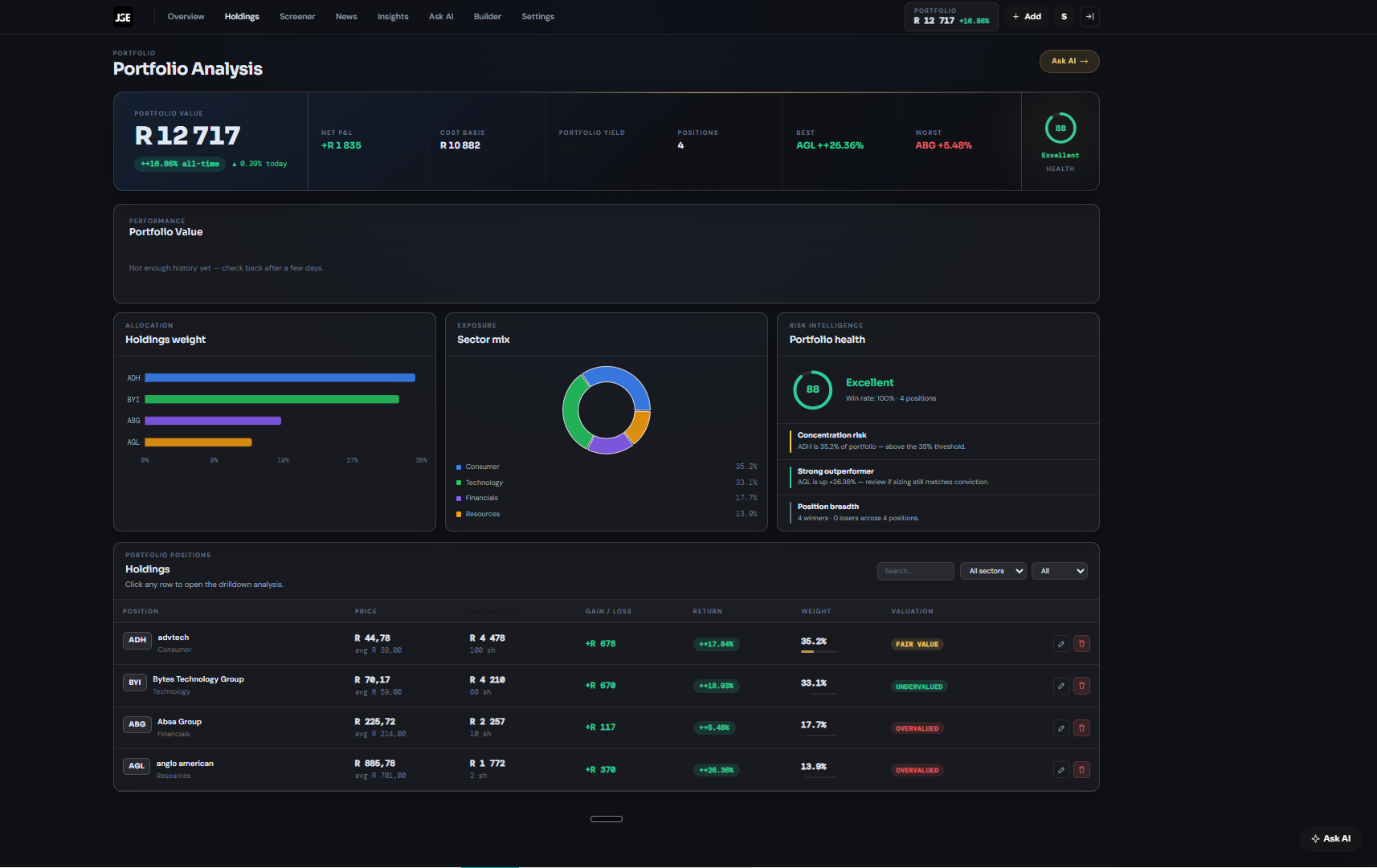
Rand Pulse is built for this exact kind of workflow. The Screener helps you compare stocks by valuation and risk signals, while the stock pages bring fundamentals, risk context, and related news into one place.
The free plan lets you track up to 3 names while you learn what a sensible research routine feels like. Premium adds unlimited tracking, advanced AI analysis, and stronger portfolio-level tooling.
Key takeaways
Risk is not one thing. It includes business quality, debt, valuation, sector pressure, and portfolio fit. A calm checklist is usually more reliable than a strong market feeling.
This content is educational and not financial advice. If you cannot explain the bear case, you probably need more research before buying.
Next step
Build a calmer stock research process
Track 3 stocks for free, use stock pages for research, and unlock advanced AI analysis plus unlimited tracking with premium access.
Get started free
Start investing with clarity
Create a free account to access beginner-friendly South African share research, portfolio tools, and Shariah-aware screening. The free plan includes up to 3 tracked stocks — premium unlocks unlimited tracking, advanced AI analysis, and full portfolio tools.