How much should you invest every month?
A practical way to decide on a monthly amount that fits real life, not social-media pressure.
Introduction
Many beginners ask how much they should invest every month because they want a clear target. The truth is that the right amount depends less on a magic formula and more on what your budget, emergency savings, debt, and goals can realistically support.
A monthly amount that is sustainable for two years is usually more useful than a larger amount you abandon after eight weeks.
Why this matters
Monthly investing is where habit meets money. If the amount is too low, you may feel discouraged. If it is too high, you may stop when life gets tight. A sensible number gives you repetition, which is one of the most valuable things a beginner can build.
The amount also influences your product choices. Small regular contributions may favour simpler lower-friction tools. Larger contributions may justify a more deliberate allocation process.
Want help turning a monthly amount into a starting portfolio? Get early access to the Portfolio Builder.
Get early accessA simple way to think about the number
Start with your income, fixed expenses, short-term obligations, and debt. Then decide what amount you could keep investing through a normal month without relying on luck. The goal is not to impress anyone. The goal is to make the habit stable.
It can help to think in layers: emergency money first, short-term obligations second, long-term investing third. These layers can overlap, but they should not be confused with one another.
South African context
South African households often deal with uneven costs, family support obligations, school costs, transport pressure, and interest-sensitive budgets. That makes flexibility more important than copy-pasting a rule from another country.
You may also be choosing between retirement products, tax-free accounts, ETFs, and direct share investing. The monthly amount affects which route feels practical.
A practical beginner example
Imagine someone earning a salary that leaves R2,000 after essentials and short-term savings goals. They might decide to start by investing R800 or R1,000 monthly rather than pushing the full R2,000 immediately. That leaves breathing room and makes the habit easier to sustain.
A second person with irregular freelance income may invest only in good months, but still choose a baseline amount so the process stays intentional rather than random.
Common mistakes
A common mistake is choosing an amount based on aspiration instead of reality. Another is investing while still relying on expensive short-term debt. Beginners also sometimes increase their investing amount before they understand where the money should go.
The amount is only one part of the plan. Asset choice, risk, and time horizon still matter.
How Rand Pulse helps
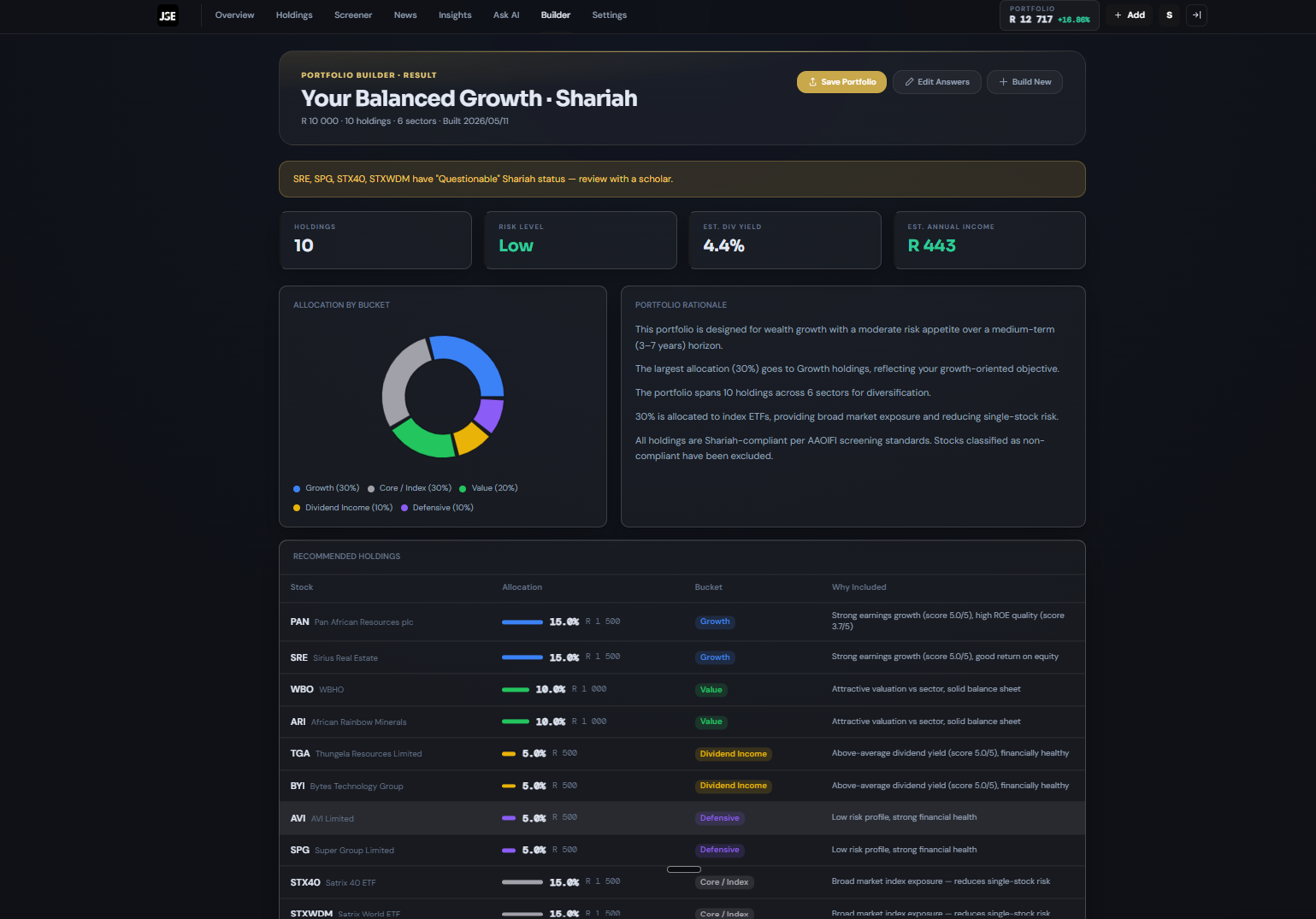
Rand Pulse helps by making the monthly amount feel more concrete. The Portfolio Builder can show how a budget and time horizon translate into a starting allocation. The Screener can help if you want to compare individual South African share ideas after that.
If you are just learning, the free plan lets you track up to 3 stocks and build a feel for how monitoring works. Premium is there when you want unlimited tracking, deeper analysis, and fuller portfolio management tools.
Key takeaways
Your monthly investing amount should be realistic, repeatable, and tied to a goal. Start with affordability, not pressure. Then improve the number as your finances and confidence improve.
This content is educational and not financial advice. A modest sustainable plan is usually a stronger starting point than an aggressive plan you cannot maintain.
Next step
Turn a monthly habit into a plan
Join the Rand Pulse waitlist to model contributions, track 3 stocks for free, and unlock full portfolio tools with premium.
Get started free
Start investing with clarity
Create a free account to access beginner-friendly South African share research, portfolio tools, and Shariah-aware screening. The free plan includes up to 3 tracked stocks — premium unlocks unlimited tracking, advanced AI analysis, and full portfolio tools.